• Patient Portal
  • Pay Bill
  • Request Appointment
MCHS_Logo_2024_BLACK
    • Cardiology (Heart)
    • Gastroenterology & Hepatology (Digestive Care)
    • Neurosurgery
    • Obstetrics & Gynecology (OB-GYN)
    • Oncology (Cancer)
    • Orthopedics & Orthopedic Surgery (Bones)
    • Primary Care
    • Spine Care
    • Sports Medicine
    • Virtual Care 24/7
    View all specialties
  • Providers
  • Minnesota

    • Albert Lea
    • Austin
    • Blooming Prairie
    • Butterfield
    • Cannon Falls
    • Fairmont
    • Faribault
    • Lake City
    • Mankato
    • New Prague
    • Northfield
    • Owatonna
    • Plainview
    • Red Wing
    • Sherburn
    • St. James
    • Waseca
    • Zumbrota

    Wisconsin

    • Arcadia
    • Barron
    • Bloomer
    • Chetek
    • Chippewa Falls
    • Eau Claire
    • Ellsworth
    • Glenwood City
    • Holmen
    • La Crosse
    • Menomonie
    • Mondovi
    • Onalaska
    • Osseo
    • Prairie du Chien
    • Rice Lake
    • Sparta
    • Tomah
    mchsmap Map view
    • VirtualCare
      Virtual Care
    • SameDayCare
      Same-Day Care
    • PrimaryCare
      Primary Care
    • SpecialtyCare
      Specialty Care
    • View all care options
    • PrimaryCare
      Billing & Insurance
    • SameDayCare
      Financial Assistance
    • VirtualCare
      Price Transparency
    • Hometown Health
    • Classes & Events
    • Self-guided wellness programs
    • Mayo Clinic Connect
    • Community Resources
  • Patient Portal
  • Pay Bill
  • Request Appointment
MCHS_Logo_2024_BLACK
Search Mayo Clinic Health System
    • Cardiology (Heart)
    • Gastroenterology & Hepatology (Digestive Care)
    • Neurosurgery
    • Obstetrics & Gynecology (OB-GYN)
    • Oncology (Cancer)
    • Orthopedics & Orthopedic Surgery (Bones)
    • Primary Care
    • Spine Care
    • Sports Medicine
    • Virtual Care 24/7
    • View all specialties
  • Providers
    • Minnesota

    • Albert Lea
    • Austin
    • Blooming Prairie
    • Butterfield
    • Cannon Falls
    • Fairmont
    • Faribault
    • Lake City
    • Mankato
    • New Prague
    • Northfield
    • Owatonna
    • Plainview
    • Red Wing
    • Sherburn
    • St. James
    • Waseca
    • Zumbrota

      Wisconsin

    • Arcadia
    • Barron
    • Bloomer
    • Chetek
    • Chippewa Falls
    • Eau Claire
    • Ellsworth
    • Glenwood City
    • Holmen
    • La Crosse
    • Menomonie
    • Mondovi
    • Onalaska
    • Osseo
    • Prairie du Chien
    • Rice Lake
    • Sparta
    • Tomah
    • Map view
    • Virtual Care
    • Same-Day Care
    • Primary Care
    • Specialty Care
    • View all care options
    • Billing & Insurance
    • Financial Assistance
    • Price Transparency
    • Hometown Health
    • Classes & Events
    • Self-guided wellness programs
    • Mayo Clinic Connect
    • Community Resources

Recent Posts

  • ColdfluRSV blog photo
    Speaking of Health
    When to seek care for cold, flu and RSV
    March 10, 2026
  • winter outdoor lady and girl 660x370
    Speaking of Health
    Is your sinus pressure a sinus infection?
    February 09, 2026
  • Izzy Iverson
    Patient Stories
    Unexpected vacation ending leads to rare tumor discovery
    February 05, 2026
Featured Topics
  • Behavioral Health
  • Cancer
  • Children's Health (Pediatrics)
  • Exercise and Fitness
  • Heart Health
  • Men's Health
  • Neurosurgery
  • Obstetrics and Gynecology
  • Orthopedic Health
  • Weight-loss (Bariatric) Surgery
  • Women's Health
Speaking of Health
Tuesday, February 28, 2023

Colorectal cancer myths and facts

Topics in this Post
  • Colorectal Health
Person with beard wearing a blue shirt

It can be easy to feel confused by screening recommendations for common types of cancer. Your health care team is a trusted resource for keeping you up to date on screenings, including screening for colorectal cancer.

Test your knowledge of why, when and how you can be screened with these myths and facts:

Colorectal cancer is rare.

Myth. Colorectal cancer is the second-leading cause of cancer-related death in men and women combined. Roughly 1 in 25 women will have colorectal cancer, and about 1 in 23 men will have colorectal cancer. To put that in perspective, when watching a football game, of all the players on the field, about one player would be diagnosed with colorectal cancer in their lifetime.

Colorectal cancer can happen when you are young.

Fact. The rate of colorectal cancer is increasing in people under 50. Rates of colorectal cancer in people under 50 have doubled since 1990. In people over 65, the diagnosis rates have been decreasing, most likely because of colorectal cancer screening.

Screening for colorectal cancer starts at age 45.

Fact. In 2021, the recommendation for colorectal cancer was updated to begin screening at age 45. This is because the rate of diagnosis is increasing at younger ages.

Colorectal cancer can be prevented with screening.

Fact. The goal of colorectal cancer screening is to prevent cancer, not just find it when it has already developed. Most colorectal cancer develops from a polyp, a small, precancerous growth. The presence of polyps can easily be identified using colonoscopy screening tests. Polyps can be removed during a colonoscopy to prevent them from developing into cancer.

Family history is the only risk factor for colorectal cancer.

Myth. While a family history of colorectal cancer influences your risk of developing cancer, other important risk factors increase the risk of developing colorectal cancer. Medical conditions include obesity and inflammatory bowel disease (IBD), and lifestyle choices, such as a diet high in red meats, smoking and alcohol use, increase risk. Because colorectal cancer is common, all adults over 45 should be screened regardless of family history.

African Americans have a higher risk of developing colorectal cancer, and American Indian/Alaska Native people have the highest risk of colorectal cancer.

A positive stool-based screening for colorectal cancer is the same as a cancer diagnosis.

Myth. A stool-based test looks for more than cancer and can identify precancerous lesions or polyps. Stool-based tests do not address the polyp if a polyp is present in the colon. A follow-up colonoscopy is needed to identify the polyp and potentially remove it.

Talk with your health care team about screening options for colorectal cancer at age 45.

Derek Ebner, M.D., specializes in gastroenterology in Rochester, Minnesota.

Topics in this Post
  • Colorectal Health

Related Posts

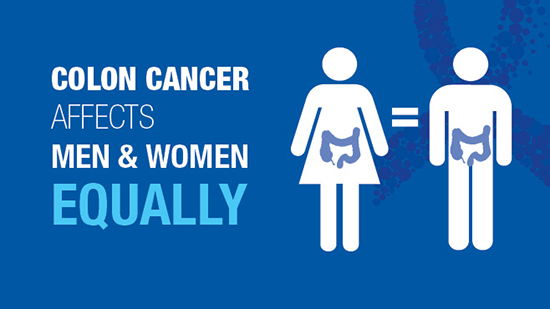
Colon cancer affects men and women equally What to expect before, during a colonoscopy
Colon cancer is the third most common cancer in the U.S. Colorectal cancer basics
Tammy LeDoux Genetic screening reveals surprising condition
Mayo Clinic Health System
About Us
Careers
Volunteer
Donate
Contact Us
Patient Care
Patients & Visitors
Classes & Events
Mayo Clinic Connect
Mayo Clinic
Resources
Referrals
Community Resources
Financial Assistance
Price Transparency
Compliance
Notice of Nondiscrimination
Notice of Privacy Practices
No Surprises Act
Terms of Use
Manage Cookie
Privacy Policy
© 2018 - 2026 Mayo Clinic Health System