Calling to schedule an appointment?
Recent Posts
-
Speaking of HealthAfib and irregular heartbeat symptoms: What you need to know
-
Speaking of HealthPink eye: Symptoms, causes and when to seek care
-
Speaking of HealthWhen to seek care for cold, flu and RSV


Monkeypox Q&A
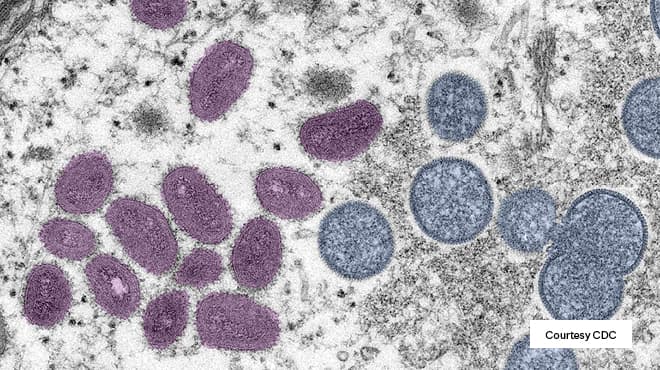
Health officials continue to monitor and track increasing cases of monkeypox, a rare disease caused by the monkeypox virus.
"Monkeypox is a virus that has mainly caused outbreaks in the continent of Africa. There have been over the last decade or two isolated outbreaks in countries outside of Africa, but this is the largest outbreak occurring in what we call nonendemic countries," says Matthew Binnicker, Ph.D., director of the Clinical Virology Laboratory at Mayo Clinic.
The World Health Organization declared monkeypox a global public health emergency, with more than 31,700 reported cases in 89 countries. In the U.S., more than 10,700 cases of monkeypox have been reported, according to the Centers for Disease Control and Prevention (CDC).
Dr. Binnicker answers common questions about the disease:
What are common monkeypox symptoms?
If someone is exposed to monkeypox virus, several days later they typically develop what we call a viral prodrome, where they may have a fever or body aches that may last for a few days and then progress to developing a rash on their body. That rash may be localized in one part of the body, for example on the chest or on the face. Or it may be more widespread across the body — in other words on the face, chest, arms and legs. And that rash can then persist for several weeks.
Someone continues to be considered infectious until that rash is completely healed, which may take up to four weeks.
How is monkeypox contracted and spread?
The primary mode of transmission of monkeypox is through direct contact with a lesion that contains the virus or direct contact with bodily fluids that have the virus in it. It's also possible for the virus to be spread through contact with contaminated fomites.
"Fomite" is a word that includes things like a bedspread or a bath towel, or even clothing. For example, if someone who has been infected with monkeypox sleeps on a bedspread, or wears clothing, those fomites could then spread the virus to others who might come into contact with them.
It is possible that monkeypox can be spread through the respiratory route, but that's believed to be a rare form of transmission. And it's thought to require prolonged exposure.
What is the test for monkeypox, and who should get tested?
When people are suspected of having monkeypox, they may present to their physician or the emergency department with a new rash, fever or viral prodrome illness. The physician will take a swab of their rash. They'll vigorously collect a sample from one of the lesions — the spots of the rash — and then they'll send that swab into a testing laboratory, including ours. The laboratory will then perform a polymerase chain reaction test.
Those who should be tested for monkeypox include people who have had direct contact with anyone who has a confirmed case of monkeypox, develop a new rash and have lived in or visited an area where there's monkeypox transmission, or come in contact with a person or a group where there is known monkeypox circulation.
If you've had contact with an animal from the continent of Africa and develop a new rash, you should be tested for monkeypox. Reach out to your health care professional to inquire about testing.
Could monkeypox become a new sexually transmitted infection?
One possibility that we need to be ready for is that monkeypox may become a sexually transmitted infection that we'll need to test for while we test for other more common well-known diseases, like gonorrhea, chlamydia and syphilis. The next several weeks to a month are really going to determine whether that is the case or whether we can stop the spread of this virus.
Are vaccines available to prevent monkeypox?
The smallpox vaccine provided about 85% protection against monkeypox because they're members of the same virus family. In today's world, people aren't receiving the smallpox vaccine because smallpox has been eradicated.
What we're seeing is a population-level decline in the level of protective immunity that was really intended to target smallpox, but also helped with prevention of spread of monkeypox. One theory why we're now seeing this outbreak of monkeypox is because the level of immunity in the global population is slowly declining.
The most common vaccine, at least here in the U.S., is the JYNNEOS vaccine. It uses a strain of a virus that's part of the monkeypox family. That strain is called vaccinia virus and can generate an immune response that protects against smallpox and monkeypox.
It's being rolled out in many developing countries, including the U.S. It will initially be used against targeted groups and populations: those who are most at risk and those who have been exposed. And then, as more vaccine becomes available in the future, we may see broader availability and access to that vaccine.
We are still in a COVID-19 pandemic. How worried should I be?
It's important to emphasize that it's unlikely that monkeypox will cause a pandemic to the scale of COVID-19 because the virus is different. It's spread in a different way.
As I mentioned earlier, the primary mode of transmission of monkeypox is through direct contact with an infected lesion. We don't think that monkeypox is going to cause millions and millions of infections like we saw with COVID-19 that's now resulted in more than 570 million cases worldwide.
People should be aware. They should especially take precautions when having sex with a new partner because that appears to be one of the main sources of transmission during this monkeypox outbreak. If a person has a new sexual partner, take precautions. And if you develop a new rash, be evaluated and request testing from your health care professional.
Mayo Clinic Laboratories is one of five nonpublic health labs selected by the CDC to help with expanded monkeypox testing using the CDC's orthopoxvirus test. This article was originally published on the Mayo Clinic News Network.
Information in this post was accurate at the time of its posting. Due to the fluid nature of the monkeypox outbreak, scientific understanding, along with guidelines and recommendations, may have changed since the original publication date.